Patients & families / Vestibular schwannoma
Vestibular schwannoma · acoustic neuroma
Also called acoustic neuroma, it grows from the sheath of the vestibular nerve, inside the inner ear canal. It grows slowly, does not spread through the body, and can be treated.
What it is
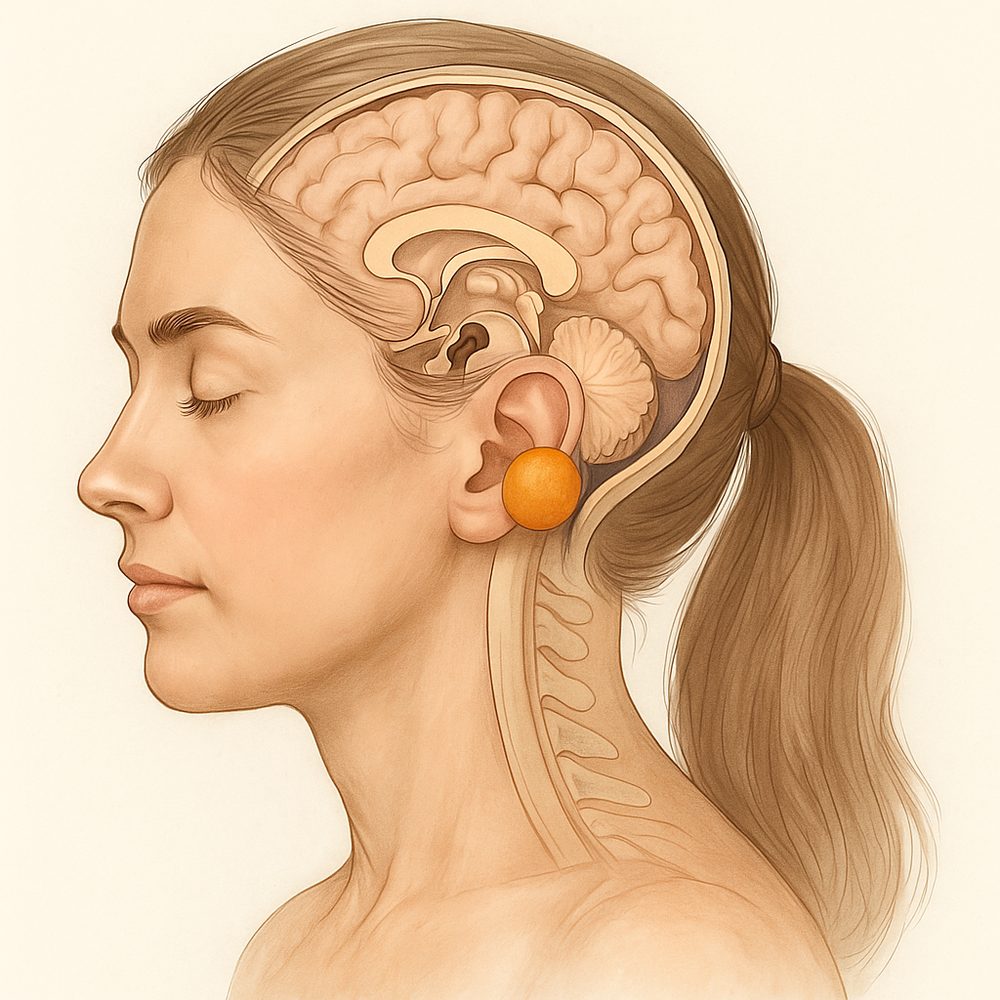
Behind each ear, side by side, run the hearing nerve, the balance nerves and the facial nerve, which moves the face. The vestibular schwannoma arises from Schwann cells, which line the balance nerve.
It starts inside the internal auditory canal and, as it grows, fills the space between the brainstem and the cerebellum, called the cerebellopontine angle. Despite the old name "acoustic neuroma", it does not arise from the hearing nerve, but it compresses it.
It almost always appears on one side only. When it appears on both sides, it is usually linked to a genetic condition called NF2-related schwannomatosis (formerly neurofibromatosis type 2).
Approximate figures based on skull base series and brain tumor registries.
Symptoms
The most typical sign is hearing loss in one ear only. Anyone who notices this should have a hearing test and, if it confirms a difference between the ears, an MRI.
Seek urgent care if you have sudden hearing loss: early treatment of sudden deafness can restore hearing, and the work-up includes an MRI.
Diagnosis
The audiogram shows the difference in hearing between the ears and tracks changes over time.
MRI with contrast confirms the diagnosis: the tumor appears inside the auditory canal and, when larger, in the cerebellopontine angle. It measures the size precisely and shows whether the tumor touches the brainstem.
Balance tests and facial nerve testing help plan treatment.

Treatment
The choice depends on size, growth, hearing, age and the patient's preference. Small tumors can simply be monitored.

For small tumors with few symptoms. Regular MRIs show whether it grows. Many stay stable for years.
When: small tumor, no growth
A concentrated dose of radiation, in a single session, stops growth in the vast majority of small and medium tumors. It does not remove the tumor.
When: small or medium tumor that is growing
Removal of the tumor under the microscope, with continuous facial nerve monitoring. It is the best option for large tumors pressing on the brainstem.
When: large tumor, growth or significant symptomsAfter treatment
The brain adapts very well to the loss of the balance nerve. The main goal of treatment is to preserve facial nerve function and, whenever possible, hearing.
Exact timelines are set by your doctor according to your case.
For your appointment
Write down the answers, or bring someone you trust.
Frequently asked questions
No. Vestibular schwannoma is benign: it does not spread to other parts of the body. The problem is compression of nerves and, when large, of the brainstem.
Hearing may worsen over time, even with stable tumors. With small tumors, some techniques try to preserve it. When hearing is lost, there are hearing aids and implants that help.
The facial nerve is attached to the tumor. With the microscope and continuous monitoring, the vast majority of patients keep a normal or near-normal face, especially with small and medium tumors.
For small tumors with no growth and few symptoms, monitoring with MRI is a safe and common option.
Research news
A randomized trial compared app-guided balance exercises with in-person physiotherapy after vestibular schwannoma surgery.
ReadAn international study followed 309 people aged 80 or older treated with radiosurgery for vestibular schwannoma.
ReadA multicenter study showed that very small vestibular schwannomas follow a calmer course than larger ones.
Read Neurosurgery